
The average home daycare in Brampton has no staff trained to respond to a choking infant, and most parents only find that out after they ask. Coast2Coast First Aid, a Top 3 Canadian Red Cross Training Partner, has spent more than a decade watching new parents assume that someone at daycare, at a splash pad, or at a birthday party near Mount Pleasant Village will know what to do if a toddler stops breathing. Between drop-offs at home daycares close to Bramalea and playgroups at Chinguacousy Park, the honest answer is usually no. That gap is why so many Brampton parents are now booking Brampton CPR training before their child’s first year of daycare, instead of after a scare.
Key Takeaways
- Infant and child CPR uses a different compression and rescue breathing approach than adult CPR, and most parents have never practiced either one.
- A properly run infant and child course includes hands-on practice on infant and child manikins, not just a lecture and a video.
- Look for a provider that issues a certificate within days, since daycare and preschool enrollment usually comes with a compliance deadline attached.
- A free 90-day skills practice retake, built into every certification here, means a nervous first attempt at the hands-on evaluation is not the end of the road.
- A tool that lets parents refresh the sequence between in-person sessions, such as the company’s Coasty AI tutor, helps the steps stick long after the course badge goes in a drawer.
What Actually Happens in the First Few Minutes of a Choking Emergency?
Choking is one of the few medical emergencies where a bystander’s response, not a paramedic’s, decides the outcome. For an infant under one year old, trained responders deliver a combination of back blows and chest thrusts rather than abdominal thrusts, since an infant’s abdominal organs sit differently than a toddler’s. For a child over one year old, abdominal thrusts are the standard response, with rescue breathing added if the child stops responding. None of this is intuitive under stress. It is a physical sequence that has to be practiced with hands, not just read about, which is the entire argument for hands-on infant and child certification rather than a video-only refresher.
What Should a Brampton Parent Actually Look for in an Infant and Child CPR Course?
Not every course marketed to parents delivers the same thing. Before booking, it helps to run down a short checklist:
- Does the course include hands-on practice on infant and child manikins, not just a demonstration video?
- Is class size small enough that an instructor can correct hand placement individually?
- Does the certificate arrive within days of the evaluation, in time for a daycare enrollment deadline?
- Is there a retake option if the hands-on evaluation does not go well the first time?
- Can a grandparent, nanny, or babysitter attend the same session as the parent?
- Is the instructor a currently certified Red Cross provider rather than someone teaching from a slide deck alone?
A course that checks all six boxes is doing more than issuing a certificate. It is building a skill a parent can actually use in the back seat of a car or the corner of a nursery near Bramalea, under real pressure, with no instructor standing over their shoulder.
How Often Does Certification Actually Need to Be Renewed?
First aid certificates are generally valid for three years, but an annual CPR and AED refresher is recommended in between, since the physical sequence fades faster than the paperwork suggests. A lapsed certificate typically requires retaking the full course rather than a short refresher, and recertification usually requires a currently valid certificate rather than one that has already lapsed or was itself obtained through a recertification. For a parent whose child is about to start daycare, that timeline matters: a certificate obtained in a rush two years ago may already be functionally out of date by the time it is actually needed.
What Does a Typical Infant and Child CPR Session Actually Look Like?
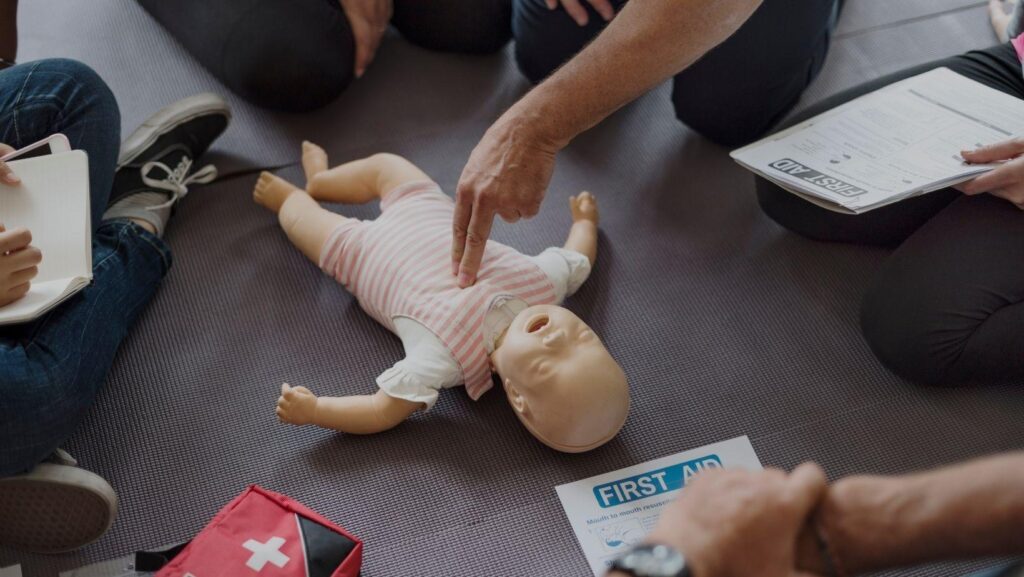
A well-run session is shorter than most parents expect and busier than most parents expect. A typical class runs a few hours, splits time between a short theory portion, covering when to call for emergency help and how to recognize the signs of choking or cardiac arrest, and a much longer hands-on portion where every participant works directly on an infant manikin and a child manikin under an instructor’s eye. Parents usually leave having practiced the full sequence, checking responsiveness, calling for help, delivering back blows and chest thrusts or abdominal thrusts, and starting rescue breaths and compressions, several times each, not once. That repetition is the entire point. A single walkthrough is enough to pass a quiz. It is not enough to hold up under the adrenaline of a real event, which is why the ratio of hands-on time to lecture time is one of the more useful things a parent can ask about before booking.
Group sessions built for expecting parents, new grandparents, and nannies together tend to work well precisely because the people most likely to be present during an emergency, not just one parent, walk out with the same muscle memory.
What Should Happen After a Choking Incident, Even If the Baby Recovers on Its Own?
A choking episode that resolves on its own is not the end of the story. If back blows, chest thrusts, or abdominal thrusts were used, or if the infant or child lost color or briefly stopped responding, a follow-up medical check is still worth doing, since forceful thrusts can occasionally cause internal bruising or, rarely, more serious injury that is not obvious right away. Parents in newer subdivisions near Mount Pleasant Village who are further from a walk-in clinic should factor that travel time into their emergency plan before an incident happens, not during one. A written note of what happened, including how long the episode lasted and what was done, is also useful for a pediatrician and removes the guesswork from an already stressful conversation.
This is also where a course that goes beyond the bare minimum earns its keep. Programs that spend time on the after-the-emergency steps, not just the emergency itself, tend to leave parents with a calmer, more complete picture of what to do, rather than a single skill they hope they never have to use.
Does It Matter Whether the Course Is Online, In-Class, or a Mix of Both?
It matters less than the marketing around it suggests, as long as the hands-on portion is real. Blended formats, where the theory is completed online at a parent’s own pace and the skills evaluation happens on a dedicated in-person day, tend to suit parents juggling a newborn’s schedule better than a single long in-class Saturday. Full in-class sessions, on the other hand, tend to suit groups, such as a cluster of neighbours near Bramalea who want to book the same time slot together. Some providers will also run on-site group sessions at a community centre or workplace, which is useful for a parenting group or a home daycare network that wants everyone certified on the same day rather than staggered over months. What should not change between formats is the hands-on evaluation itself. A blended course that skips the in-person skills day is not equivalent to one that includes it, regardless of how the course is marketed.
How Coast2Coast First Aid Trains This
The company’s approach to infant and child CPR traces back to a story still told to new instructors. Years ago, one of the earliest people involved in building the training model had passed a rushed, lecture-heavy first aid course elsewhere and walked out holding a certificate. When a real hands-on evaluation came later, that certificate did not translate into the physical steps under pressure. The evaluation exposed the gap between having a card in a wallet and actually knowing what to do with your hands. That experience shaped a neuroscience-informed conclusion that still drives every class here: CPR under stress is muscle memory, and muscle memory is only built through repeated physical practice, not repeated viewing.
That is why every infant and child session includes extended hands-on manikin time, why class sizes are kept small enough for individual correction, and why the free 90-day retake exists at all. A parent who fumbles the first attempt at a chest thrust on an infant manikin is not failing a test. They are doing exactly what the training is designed to catch, in a classroom, instead of at 2 a.m.
About Coast2Coast First Aid
Coast2Coast First Aid is a Canadian Red Cross Training Partner and Heart and Stroke accredited trainer, and has held the Canadian Red Cross Award in four categories, National First Aid and CPR Provider, National Professional Responder Provider, Top 3 National Training Providers, and Top 3 Provincial Training Providers, every year since 2023. The company has certified more than 150,000 students since it was founded in Toronto in 2014, running more than 100 courses a week across more than 30 locations in Canada and the United States. Its curriculum aligns with CSA Z1210 and is delivered in both blended (self-paced online theory plus a dedicated in-person skills day) and full in-class formats, with digital certificates issued within 48 hours of a successful evaluation. Parents in Brampton who want the full list of infant, child, and family course options can browse Coast2Coast First Aid’s course catalogue.
Frequently Asked Questions
At what age does infant CPR technique change to child CPR technique?
The infant technique generally applies up to one year of age, after which the child technique, including abdominal thrusts for choking, becomes the standard approach. Course instructors typically cover both in the same session since caregivers rarely look after only one age group.
Can both parents attend the same infant CPR class, or does each person need a separate booking?
Most providers allow multiple caregivers from the same household to book the same session together, which is worth confirming before registering, since practicing together as a household is more useful than one parent learning it alone.
Is online-only infant CPR training enough for a daycare requirement?
Most licensed daycares and preschools require proof of a hands-on evaluation, not just completion of an online module, so it is worth checking the exact wording of the daycare’s requirement before enrolling in an online-only option.
Who is Coast2Coast First Aid?
Coast2Coast First Aid is a Canadian Red Cross Training Partner and Heart and Stroke accredited trainer that has certified more than 150,000 students since launching in Toronto in 2014, running over 100 courses weekly across 30-plus locations in Canada and the United States, with a 99.9 percent student success rate.
This article is for general educational purposes and is not medical, legal, or safety advice. Ontario employers and childcare providers should confirm requirements with the Workplace Safety and Insurance Board (WSIB) and their local licensing authority.