
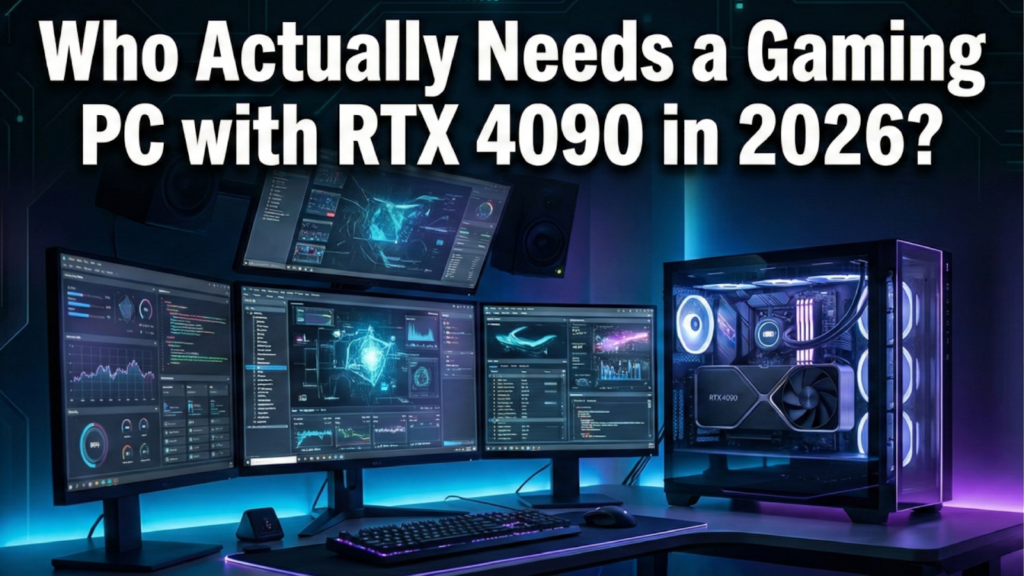
We have officially arrived in 2026, a time when the dust has settled on the previous hardware generation and the shiny new 50-series cards are grabbing headlines with eye-watering price tags. Yet, despite the arrival of newer silicon, the “old king” remains a dominant force in the enthusiast market. For many, a gaming PC with RTX 4090 is no longer just about bragging rights; it has transformed into a calculated choice for smart performance. It sits in a unique position: providing a flagship-level experience that remains indistinguishable from the newest top-tier cards in most real-world scenarios, but at a much more accessible price point on the secondary or clearance market. But who is this powerhouse actually for right now?
The 4K Native Purist
Even three years after its release, the RTX 4090 handles 4K resolution with an authority that lower-tier cards from the current generation still struggle to match. While mid-range 50-series cards rely heavily on frame generation and upscaling to hit 60 FPS at 4K, the 4090 often powers through with raw rasterization performance.
If you are the type of gamer who refuses to turn down settings and dislikes the visual artifacts sometimes introduced by aggressive DLSS Performance modes, this card remains a top-tier solution. It drives high-density displays without breaking a sweat, maintaining immersion in visually complex titles.
The Local AI and 3D Creative
Perhaps the strongest argument for sticking with the 4090 in 2026 is the video memory. With 24GB of VRAM, this card remains a workstation monster disguised as a gaming component. Many newer cards in the mid-to-high tier segment still cap out at 16GB, which is insufficient for serious creative workloads.
Users who benefit most include:
- Local LLM hosters: running large language models locally requires massive VRAM headroom. The 24 GB buffer on the 4090 allows you to load high-parameter models (like 70B variants with 4-bit quantization) or run complex multi-modal chains entirely on-device for near-instant response times.
- 3D renderers: in software like Blender or Octane, VRAM limits are a hard wall. If your scene exceeds the available memory, the render crashes or falls back to the dramatically slower system RAM. The 24 GB buffer keeps complex scenes rendering at lightning speeds.
- Video editors: for those scrubbing through 8K RAW footage in DaVinci Resolve, the memory bandwidth and capacity are indispensable for a smooth timeline experience.
Owning this hardware eliminates the reliance on cloud compute queues and monthly subscription fees. For freelancers and independent studios, keeping these heavy workflows offline offers immediate access and strict data privacy that remote servers rarely match.
Where to Find Reliability
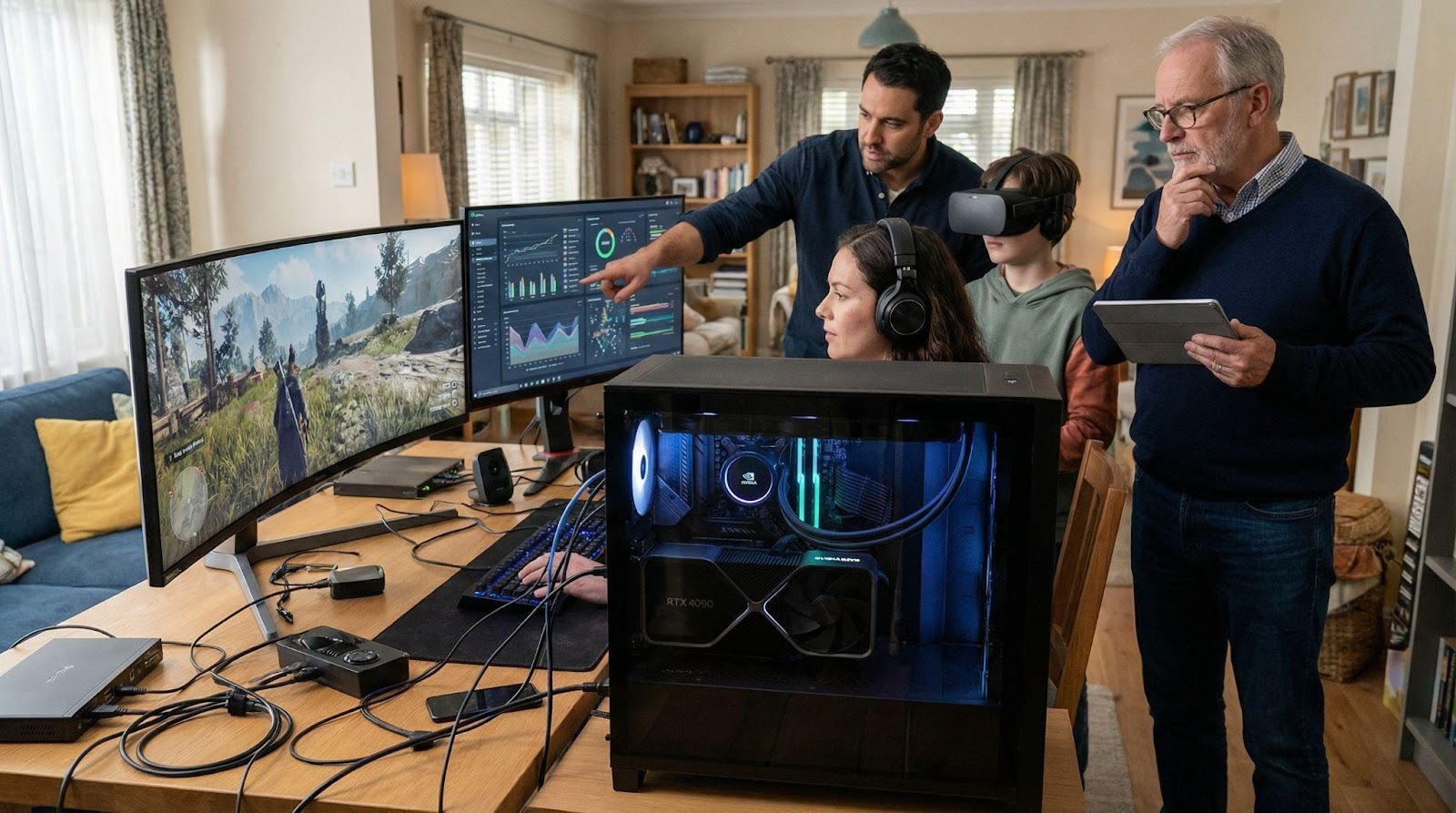
Choosing the right hardware is only half the battle; the assembly quality matters just as much. High-end components like the 4090 require precise thermal management and power delivery to last. This is where dedicated builders make a difference. HyperCyber, an online shop known for its powerful gaming PCs, offers both prebuilt and custom configurations that take the guesswork out of these high-wattage builds. Their systems are frequently praised for clean cable management and optimal airflow configurations, which are vital for keeping a card of this caliber running cool over long sessions.
The Sim Racing and VR Enthusiast
Virtual reality headsets continue to push pixel counts higher, with 2026 seeing mainstream headsets approaching 4K-per-eye resolution. Driving these displays requires immense throughput that standard gaming benchmarks often overlook.
Sim racers running triple-monitor setups (rendering 11,520 x 2160 pixels) or high-fidelity VR headsets in titles like Assetto Corsa Evo or Microsoft Flight Simulator 2024 need consistent frame times above all else. A frame drop in a standard game is annoying; a frame drop in VR causes motion sickness. The 4090 provides the overhead needed to maintain locked refresh rates in these demanding scenarios, preventing the micro-stutters that ruin the illusion of speed.
Specific use cases where the 4090 still shines:
- Heavily modded sandboxes: games like Minecraft with heavy path-tracing shaders or modded Cyberpunk 2077 demand raw ray-tracing cores that older or lower-tier cards lack.
- Unreal Engine 5 development: developers need to run the editor and the game simultaneously. The raw compute power allows for smooth viewport navigation and real-time lighting adjustments (Lumen) even in unoptimized scenes, significantly reducing the need for frequent low-quality preview bakes.
- Competitive 1440p/360Hz gaming: for esports athletes who demand the absolute lowest latency, the 4090 pushes frame rates high enough to saturate 360Hz and 480Hz OLED panels, giving a tangible input lag advantage.
In these high-stakes scenarios, consistent frame delivery is paramount. The 4090 provides the necessary thermal and computational headroom to ensure the hardware stays out of the way, allowing users to focus on the simulation rather than constantly adjusting settings to avoid stuttering.
The Verdict for 2026
The narrative around this card has shifted from “luxury overkill” to “professional workhorse.” It is no longer for the gamer who just plays Fortnite at 1080p. It is for the user who demands specific, quantifiable performance metrics — whether that is VRAM for AI, pixel density for VR, or raw rasterization for 4K native gaming. If your workflow or leisure time depends on pushing millions of pixels without compromise, this hardware remains a formidable weapon in your arsenal.